

The 2026 trends in 3D printing design are not a gradual evolution. They are a break. Engineering materials that once required industrial machinery now come from accessible printers, automatic control corrects errors in real time without human intervention, and sustainability has gone from slogan to mandatory design criterion. If you work with modeling, prototyping, or physical object production, what happens this year redefines what you can create and how you can monetize it.
Table of contents
- Key points
- 1. Advanced materials and their impact on 3D design for 2026
- 2. Real-time automatic control: the silent change
- 3. Personalization and business models for creative designers
- 4. Sustainable design: manufacturing without waste in 2026
- 5. Software and workflow: integration and advanced rendering
- My perspective on what will really change in 2026
- Design and create with Reimii: products that inspire
- FAQ
Key points
| Point | Details |
|---|---|
| Accessible high-performance materials | PEEK, PEI/Ultem, and carbon fiber Nylon enable metal replacement in functional desktop applications. |
| Real-time automatic control | Computer vision systems detect and correct thermal deviations without retraining the model for each design. |
| Customization as a competitive advantage | Customized products with differentiating value generate more revenue than generic mass printing. |
| Sustainable design by default | Producing on demand and designing repairable parts reduces waste and extends product life. |
| Integrated software and fast workflow | Tools with real-time photorealistic rendering speed up iteration and improve final quality. |
1. Advanced materials and their impact on 3D design for 2026
The biggest leap in additive manufacturing this year doesn’t come from hardware. It comes from what you put inside. In 2026, materials like PEEK, PEI/Ultem, and carbon fiber Nylon allow replacing metals in demanding applications: aerospace parts, temporary medical implants, automotive components that withstand high temperatures.
The comparison with metals is no longer speculation:
| Material | Thermal resistance | Stiffness | Relative weight | Cost per kg |
|---|---|---|---|---|
| PEEK | Up to 250 °C | High | Low | High |
| PEI/Ultem | Up to 217 °C | Very high | Low | High |
| Nylon CF | Up to 150 °C | High | Very low | Medium |
| Stainless steel 316L | Up to 870 °C | Very high | High | Very high |
What changes with these materials is not just the outcome. It’s the design mindset. Using PEEK or PEI means reconsidering geometries and thermal properties from the first sketch, not just swapping the filament and expecting the same result. A part designed for PLA, redesigned in PEEK without adjustments, can fail or, worse, waste expensive material.
Key aspects for designing with high-performance materials:
- Calculate thermal contraction from the start, especially in long geometries or with tight tolerances.
- Increase bed and chamber temperature according to manufacturer specifications to avoid delamination.
- Prefer geometries with functional infills (gyroid, cubic) over linear infills to maximize strength-to-weight ratio.
- Validate the supplier’s mechanical properties with test pieces before committing to production.
Professional tip: If you are exploring carbon fiber Nylon for the first time, start with the hardened steel nozzle before adjusting the temperature profile. The fiber destroys brass in a few hours and ruins the dimensional accuracy of the part.
2. Real-time automatic control: the silent change
The ORNL lab has developed a computer vision control system that detects thermal deviations during printing and automatically adjusts parameters, without needing to retrain the model for each new design. In practice, this means the printer corrects in real time what previously required trial, error, and accumulated experience.
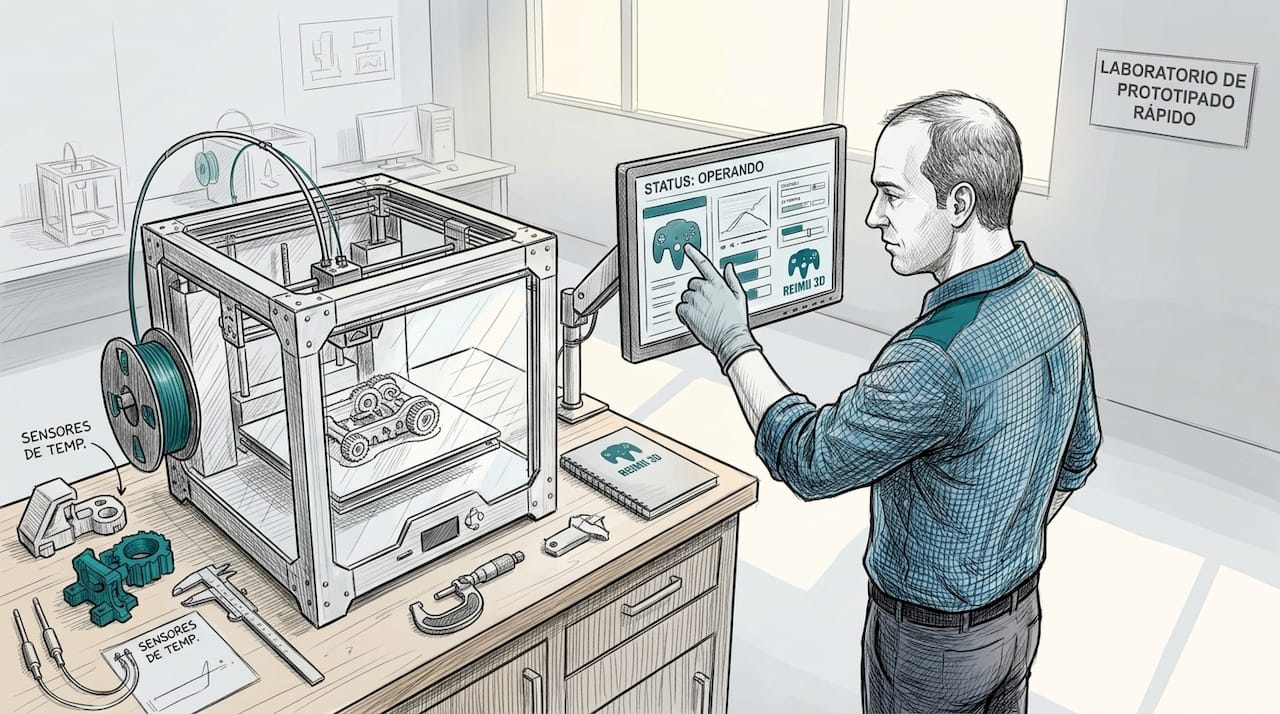
For a designer or artist, the impact is direct. Fewer failed parts. Less time calibrating. More time creating.
This type of adaptive thermal control turns 3D printing into a process that responds to variable conditions, not one that depends on static prior settings. The leap from lab to mass production still requires robustness in varied industrial environments, but the trend is clear: intelligent automation will replace much of the current empirical experience.
In the field of home and semi-professional hardware, CoreXY architectures lead in 2026. CoreXY printers reach speeds of 400 to 500 mm/s compared to the typical 80 to 150 mm/s of classic bedslinger architectures. Models like the Creality K1 (from €449) or the Bambu Lab P1S (from €649) have democratized that speed.
Concrete benefits for creative workflows:
- Prototype iteration up to four times faster than with bedslinger printers.
- Lower residual vibration, which translates into better surface quality at high speed.
- Compatibility with multi-material profiles for parts with combined colors or properties.
Professional tip: Good calibration and a well-configured slicer can make more difference than the hardware itself. Bambu Studio and Orca Slicer are essential to fully unlock the real potential of any modern machine.
3. Personalization and business models for creative designers
Effective monetization in 3D printing doesn’t come from printing cheaper. It comes from turning designs into products with differentiating value that the mass market can’t easily replicate. The personalization niche is, in 2026, the biggest revenue driver for independent designers.
The most profitable business models follow a clear pattern:
- Personalized mobile accessories. Cases with initials, engravings, or unique geometries. High margin, fast production, steady demand.
- Themed organizers and storage. From desk organizers to boxes for collectible cards. Functionality plus visual design justify premium prices.
- Jewelry and fashion accessories. Resin and TPU allow creating unique pieces that compete directly with conventional handmade jewelry.
- Miniatures and collectibles. The board games, role-playing, and collecting segment generates very loyal communities willing to pay for exclusivity.
- Spare parts and repair components. An undervalued niche with real demand: discontinued parts, adapters, or components no longer produced by the manufacturer.
Amazon’s advice for new entrepreneurs remains valid: start with a specific category and expand based on real sales data, not intuition. Collectibles with personalization (initials, phrases, cultural references) have the best margins when the design is solid.
To sell, platforms like Etsy, independent Shopify stores, or TikTok Shop are attracting a lot of traffic in 2026 for products with a strong visual identity. If you want to understand how to make your product stand out on channels like TikTok with current trends, it’s worth exploring specific content strategies for printed physical products.
4. Sustainable design: manufacturing without waste in 2026
Additive manufacturing has a structural advantage that few technologies can match: it produces without waste, using only the necessary material, and facilitates repair and component replacement. In a context of increasing environmental pressure, this ceases to be a technical curiosity and becomes a selling point.
The principles of sustainable design applied to 3D printing in 2026 include:
- On-demand production. No physical stock, no overproduction, no inventory waste.
- Modular and repairable parts. Designing with detachable joints and replaceable components extends the overall product lifespan.
- Geometries optimized for minimal post-production. Fewer supports, less sanding, less waste. This requires planning geometries from the design stage with integrated print orientation.
- Recycled or bio-based filaments. Recycled PLA, rPETG, and environmentally certified materials are gaining quality and availability.
A tangible example: the custom prosthetics sector uses 3D printing to produce specific adaptations for each patient, eliminating waste from failed adjustments with standard parts. In industrial components, manufacturing an exact replacement on demand avoids maintaining physical inventories that expire or become obsolete.
The conscious designer of 2026 integrates sustainability in the modeling phase, not as an additional step at the end. Thinking about finishes and geometries from the start reduces costly iterations and discarded parts.
5. Software and workflow: integration and advanced rendering
3D design software in 2026 has closed the gap between visualization and production. The most significant tool in the AEC and product segment is Maxon's Redshift, which now integrates directly with Vectorworks and Autodesk Revit to offer real-time photorealistic rendering within the same CAD/BIM environment.
For product designers and 3D artists, this means visual validation no longer requires exporting to an external program, waiting hours for rendering, and correcting again. The iteration cycle compresses from days to minutes.
Key software trends for 2026:
- Intelligent procedural libraries. Materials and textures that automatically adapt to the object's scale and orientation.
- CAD/BIM compatibility plugins. Interoperability between parametric design tools and real-time rendering engines.
- AI integration for geometry generation. Generative design tools that propose optimized structural variants based on manufacturing constraints.
- Slicers with predictive analysis. Bambu Studio and Orca Slicer incorporate layer simulation to detect weak points before printing.
Creative productivity in 2026 depends less on mastering a single program and more on building a workflow that seamlessly connects modeling, visual validation, and print preparation.
My perspective on what will really change in 2026
I have followed the evolution of additive manufacturing for years, and what catches my attention most in 2026 is not speed or materials. It is the automation of judgment. When a machine corrects in real time what used to require years of experience to detect, the threshold for access to quality functional design drops dramatically.
This is double-edged. On one hand, more people can create competently. On the other, the difference between a mediocre product and an exceptional one stops being about technique and shifts to creative vision and user understanding.
What I have learned is that choosing the right materials and mastering the software matters less than understanding what real problem your piece solves. Sustainability is not optional from a strategic point of view: buyers in 2026 ask about the material's origin and durability before purchasing. And customization without design identity is just noise in a saturated market.
My specific recommendation: choose a small niche, master it deeply, and build a catalog with visual and functional coherence. Understanding what makes a 3D printed product unique from the collector's or end user's perspective is the most valuable exercise you can do before scaling production.
— Marina
Design and create with Reimii: products that inspire
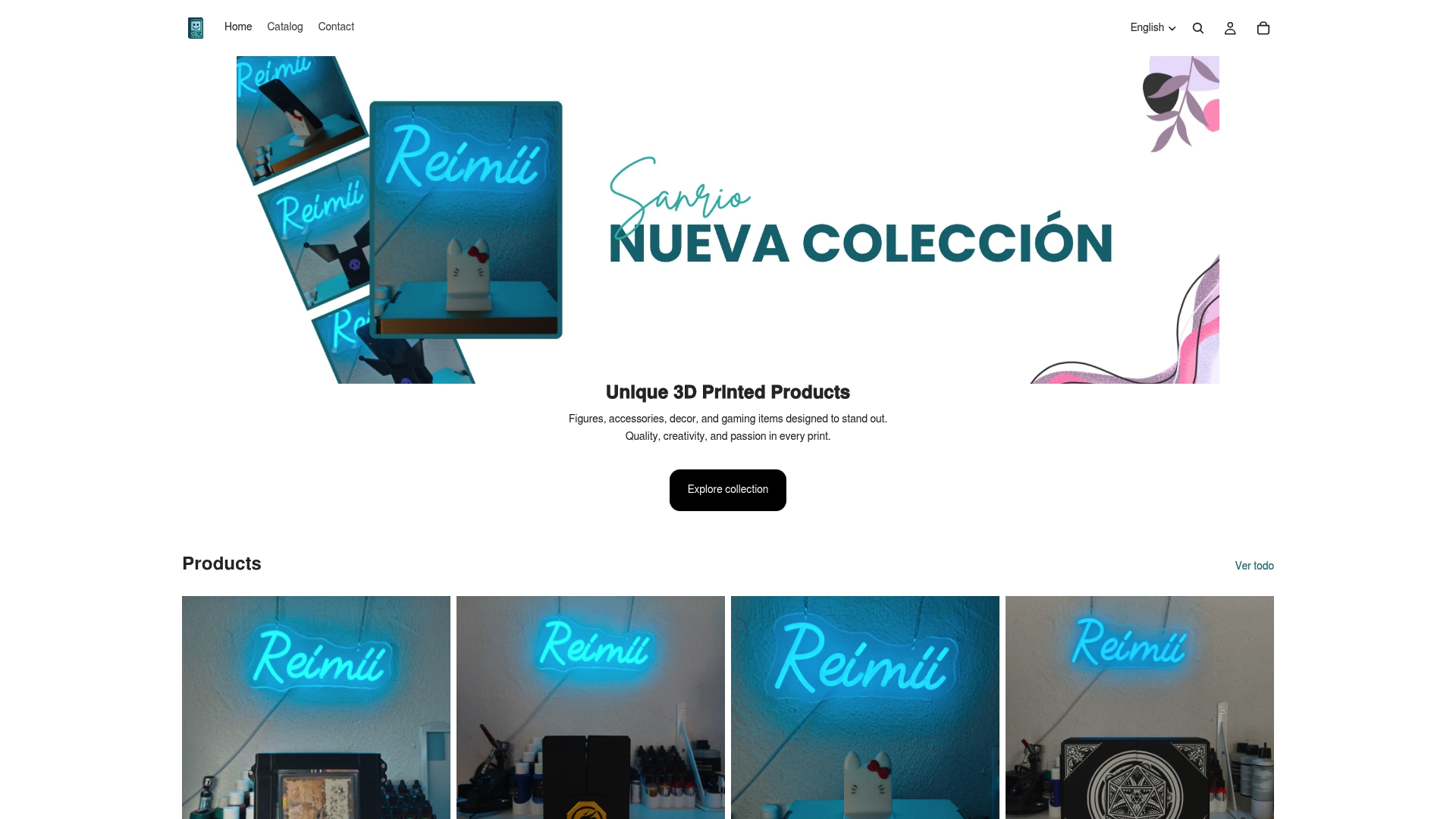
If the 2026 trends have given you ideas, Reimii is the place where those ideas take physical form. Specializing in 3D printed products for collectors and card players, Reimii combines material quality with design that truly stands out. From accessories for TCG to themed kits for D&D, each piece reflects what it means to design with purpose. Discover the full selection at the Reimii store or explore directly the most popular products to find your next favorite piece. If you are a card player, the Reimii TCG collection has exactly what you are looking for.
FAQ
Which materials lead 3D printing in 2026?
PEEK, PEI/Ultem, and carbon fiber reinforced Nylon are the reference materials for high-performance functional applications, with increasing standardization also in metals like grade 5 titanium and 316L stainless steel.
Which printer architecture is best for design in 2026?
CoreXY architectures reach speeds of 400 to 500 mm/s compared to 80 to 150 mm/s of classic bedslinger designs, making them the preferred choice for creative workflows with rapid iteration.
How is sustainable design applied in 3D printing?
Planning geometries with minimal supports, using on-demand production to eliminate excess inventory, and designing modular parts that allow repair or component replacement without discarding the entire product.
Which software stands out for 3D design in 2026?
Maxon's Redshift integrated with Vectorworks and Autodesk Revit allows real-time photorealistic rendering within the CAD/BIM environment. For print preparation, Bambu Studio and Orca Slicer are the most powerful slicers on the current market.
How to monetize 3D printed products in 2026?
The key is to turn designs into products with a clear differentiating value: personalization with initials or unique designs, specific niches like collectibles or gaming accessories, and channels with high visibility such as Etsy or TikTok Shop for specialized physical product niches.
0 comments